Groove Tubes has been around for a number of years now, I have used their products for years, and am continually being asked questions in regard to their products. There are a few misconceptions in regard to Groove Tubes, and I would like to steer folks in the correct direction. On an Internet website of a tube vendor, they say the following which I would like to clarify, or at least give my personal viewpoint: "Groove Tubes is not a tube manufacturer, which is why we don't carry their products. Neither, for that matter, do Fender, Ruby Tubes and a host of other companies manufacture tubes. All these companies buy tubes from the same people we do: the companies who actually build tubes, such as Sovtek, Svetlana, and Tesla and then they relabel them with their logo." ("thetubestore") Fender and Ruby do not manufacture tubes. Ruby buys tubes from the same sources as the other folks, and in the case of Fender, they buy their tubes from Groove Tubes for most of their better amplifiers as standard equipment to assure reliability. There are also a number of very high end amplifier manufacturers that also use Groove Tubes as standard issue, and DO NOT use the vendor that made these comments. While Groove Tubes is not a manufacturer, they do have direct involvement with the design and changes of a number of tubes in a number of factories. A few examples of this are: 1. The GT KT-66 and KT-66HP, which some say are the same tubes that come from China and sold under the "Valve Art" name, as well as other names, are not the same tube. If you look at the Groove Tubes offering, one of the changes is the "getter". On the GT tube, it is a different part and design than the "washer" as in the other tubes. 2. The GT EL-34LS, which some refer to as the same tube as the JJ/(Tesla) offering has a different plate structure with integral heat sinks. This was developed specifically for Groove Tubes and is not for sale from other sources. 3. The bases on a number of their tubes are done to their specifications as the common base did not meet their requirements. 4. The new 6L6GE is a tube due out soon that is a tube of their own design and manufacture. 5. In speaking with thetubestore, I was told they do not sell "re-branded" tubes. I asked them to look at the differences in the plate structure of the JJ EL-34, asked them to note the differences in the getter assembly of the KT-66 and KT-66 HP, and inquried as to how they are going to offer their customers the GT 6L6GE. They did not respond to this in any way I could understand. I guess if Groove Tubes makes "re-branded" tubes as they tell folks, then perhaps AMG makes a re-branded Mercedes, "M" makes a re-branded BMW, and Saleen makes a re-branded Mustang. The Tube Store goes on to state: "We believe in providing honest value for your money when purchasing tubes, and in letting you decide exactly which brand and type you would like to buy. This is the only way you can compare the different sounds of different tubes in your amp - if you know exactly what's in there." Groove Tubes has always been open to letting folks know what factory produced the tubes, so you do know "exactly what's in there" "Our Perfect Pair power tubes are matched as closely as anyone in the tube industry, and have the most accurate, bias-free operation of any tube numbering system, including Groove Tubes. Our "Tested for Noise" pre-amp tubes are certain to be as quiet as any you'll find at twice the price. " Testing is a broad term, as is matching. A lot of vendors test little more than current draw of a tube. In the case of The Tube Store, they go on in other areas of their website to state that the only thing that matters is current matching, and looking at some of their samples in our tests, I would believe that, as the curves and transcondcutance may or may not have been checked. There is also the quality control aspect even before a tube is put into a matching system. I do not know what Groove Tubes does in full, but I do know that they test for things such as gas leakage as one of their many tests. This test is the sort of test that will find a tube that might have died in the middle of a performance after newly installed, or perhaps in a few performances. "We hope you'll agree with us that it's better not to pay extra for "rebranded" tubes, and that it also makes more sense to know exactly what tube you're buying. " Again, there is more here than "rebranding" as they have implied. As far as the GT logo, it even has its own advantage ... it is heat sensitive paint that will turn brown when the tube is overheated, thus giving you an indication that your amp is underbiased and running too hot. The slight increase in cost is part of the price one pays for other things too. Some of these things were mentioned above, such as internal components that were re-engineered or re-designed. Bases that were of better materials, pins of better metals and plating. All these items, and most importantly, their selection process, seems to in my experience, lead to increased performance. With one particular client, he has his amps set to what can only be described as "totally out of design spec". That is how he gets his distinctive sound. Tubes from various other vendors will only last three to five evenings. Groove Tubes output tubes will last from seven to over ten. These are supposed to be "the same tubes from the same factory", but in practice, there is a difference. The Groove Tubes rating scale is the same scale, year after year. What we have found is that when we test tubes from some other vendors, we see their scale "sliding". When we do our tests, we go to a number of sources and purchase the tubes at retail or posted prices. We procure 6-7 sets from the USA, and 3-4 sets from Europe vendors. We tell them we are currently using "Groove Tubes #5" tubes in whatever target amp we specify at the time. What we have possibly discovered, is that as some vendors get their various batches in, as the characteristics go up and down, they are applied to what may be a bell curve. It seems like the mid range of their batches moves over time. On a old set of new GT EL-34 tubes that was rated at a S6, tubes purchased recently as an S6 were within 0.4 mA of the old set, and the traces were so close that they could not be accurately identified. Lastly, and most often overlooked my many .... PACKAGING! Everybody has warranties in regard to matching. Why? Because even the best match in shipping can change. Tubes are fragile. There are a lot of delicate hand assembled parts in that glass bottle, and they do not take well to shipping damage at times. If you keep your tubes at home, you are pretty safe, but if you are on the road with tubes in cases which are thrown on busses and trucks, you may see a lot more tube failures right after installing. I typically recommend GT for my clients that are on the road. Their packaging in those little tubes with the familar grey foam donuts around the tube is magic. I do not have to repack GT products, and they come through most any situation intact and un-altered. I cannot remember the last time I had a microphonic preamp tube from these folks. I cannot say the same of some others. The NOS folks such as KCA and Tube World, do a wonderful job with NOS tubes. They will let you know the current draw, transconductance, and some other factors too. There are some very good tube folks out there, and I just wanted to let some folks know that I wanted to clear the air from my point of view in regard to Groove Tubes after some of my discussions and questions on the various forums and discussion groups in which I participate. Remember .... there is more to matching tubes than plate current. If you do not believe this and are in the Southern California area, I'd be more than happy to show you on some specialized equipment ... and on a scope. Two tubes with the same current draw can be very different animals. Groove Tubes website |
| Groove Tubes |
| Be sure to scroll down and see the review on the new Groove Tubes "NVM" (new vintage manufacture) 6L6GE which testing started on 3/6/02 - Now shipping as of May 2002! |
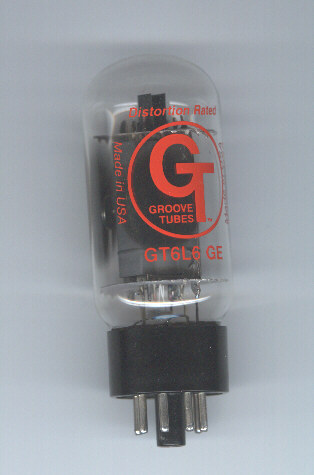
| Preliminary first report on the Groove Tubes 6L6GE tube 3/6/02 - Guitar Amplifier Blueprinting - West Hills CA. We hear the term NOS (new old stock). After seeing some of the initial curve traces of this tube, I had to wonder if a new "moniker" such as NVM (new vintage manufacture) or NMOS (newly manufactured old stock) seemed more appropriate. When talking to the folks at Groove Tubes, the term "reissue" was said by one of them, but "reissue" as in amplifiers, can mean the same circuit, but with changes. Items such as printed circuit boards or other changes are a bit different than the originals. I looked at this tube very closely. To my way of thinking, it is anything but a reissue. It is an original GE tube made today. It is made on machines from decades ago. The parts inside are of the same metals, dimensions, and design as the GE. The coatings are of the same chemical content, formulations, and thickness. Even the glass case is the same glass formula, thickness, and dimensions. The getters are side getters, and the mica spacers are identical to the originals, made of the same material on the same machines as the originals. Well, sometimes a copy of something can be a copy visually and physically, but in practice it can be a different matter. So … it was off to the vacuum curve tracer and scopes, meters, and loads. First, a standard was needed. What better standard than the original GE data sheets. These sheets show what was expected from an "average" tube. As we changed voltages, one thing became more clear as time passed, this tube (which is still not released) did not have a Groove Tubes rating number, but probably would have been a #6. The curves (as some of the charts show), were just a touch stronger than the average GE tube. This was well within the range of a number of the originals. These curves are as linear as anything we have tested. The usable range of this tube as various voltages was wider than the Svetlana, Electro Harmonix, or JJ Tesla tubes. The wider range is not a plus or minus, just an indication of a very well engineered piece of equipment. Listening tests done earlier showed this tube to be a winner to the folks tastes that were present. This tube was tested in the new Groove Tubes Solo Class A amp, in both the combo and head version. It was also tested in Mikey Wright’s Fender Custom Shop Vibroverb. Mikey can probably give the ability to have a listen if you are in the area. If you are interested, drop me an email. I normally refrain from listening tests as these are so subjective, but I will say that my old favorite KT-66 tubes will possibly be replaced by these 6L6GE’s when they are commercially available in quantity. For now, this tube is in something of BETA test, with about 30 or so musicians out there. This is the first phase of out testing, and I will post more as I have more to tell you all. I will say that so far, this is the best "data wise" 6L6 available. As far as sound quality, that is subjective. If you like the original Fender sound, than this tube will be work investigation. Also down the road, Groove Tubes is developing a 6CA7 (EL-34). The USA 6CA7 had a higher vacuum than their Europe counterparts, and were of a heavier construction also. This may be the ticket for the folks out there that want a strong EL-34 type tube with a high degree of reliability. Now, I did not see any spare equipment lying around to make another tube type at Groove Tubes … but … maybe if I can get a lot of people pushing hard enough, we can get them to make a "NVM" versions of a 6V6 !!! Expected availability of this tube is expected by early summer. |
 |
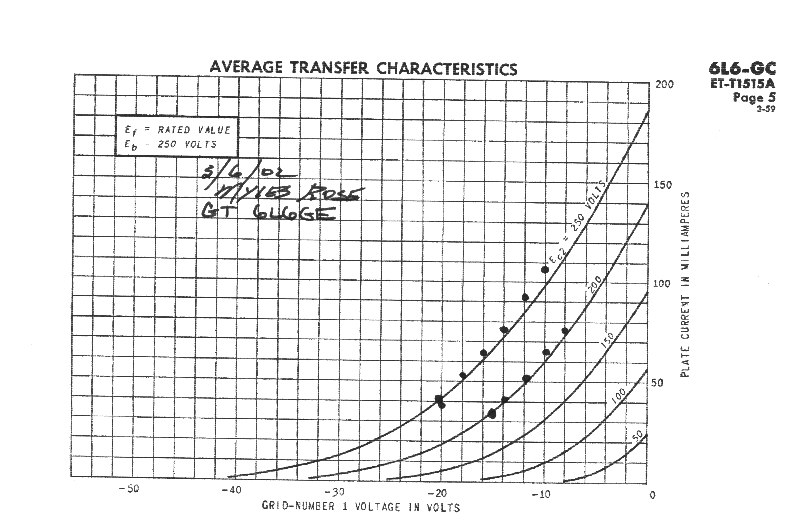 |
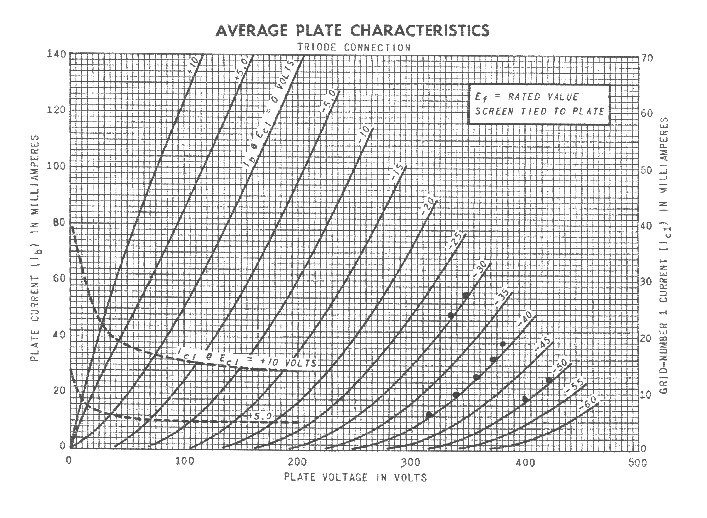
| The above are the Groove Tubes 6L6GE points plotted using the original GE average tube data chart. The plots were done from 150 volts to 500 volts and in both triode and pentode configurations. The pentode charts versus an original GE sample were too close to identical to graph. A scope camera is being procured to show those curves. |
 |
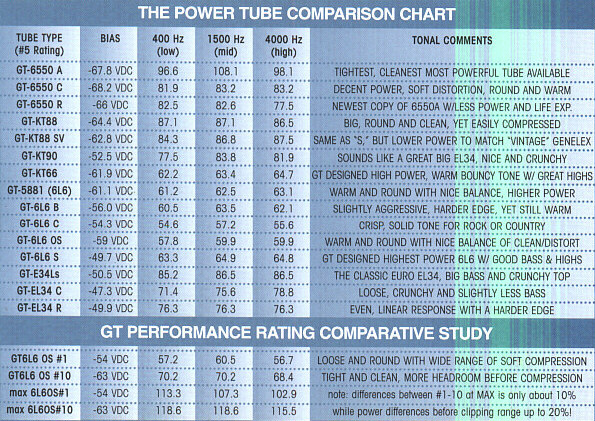 |
| Hopefully this chart below will help some folks understand the Groove Tubes rating system of 1-10. This is the lower portion of the chart, the "comparative study". The numbers here are WATTS at various frequencies. The numerically lower set of numbers is the clean wattage that was generated with the #1 and #10 set of the same tube. The "max" numbers below the OS numbers are then the maximum wattage developed with the same tubes. What this is showing, is that it is less a matter of power output and more a matter of distortion charicteristics that their 1-10 numbers indicate. In the last example above, we see see than an OS #1 at max in one frequency range produces 113.3 watts in the amp (a Groove Tubes Solo 75 amp), and a OS # 10 produces 118.6 watts. Remember, it takes TWICE the power to give you 3db more of power. So the amount of power change here is very small across their 1-10 range, it is more of the point and manner in which the tube distorts. In the upper part of the chart, you again see wattage at various frequencies with a number of the tubes that Groove Tubes offers. This is a nice study also. The bottom line here is; Lower numbers will start to distort at lower volume settings on your amp, and have more dynamic touch and feel. These are the GT 1-3 range, and the Fender "blue" painted tubes. Many Jazz or Blues players like this range, and they work well for recording where levels are going to be lower, or in smaller venues. Medium numbers are the most versitile, will drop into most amps and be very close to most factories bias settings, and are the best general choice for most players wanting a versitile well rounded amp. These are the GT 4-7 range, and the Fender "white" painted tubes. The range of 4,5,6 are able to be used in Mesa Boogie fixed bias amps, and on the Mesa scale convert roughly to: Mesa scale Groove Tubes scale Red 4 Yellow 4 Green 5 Gray 5 Blue 6 White 6 High number will have to be driven at higher volume levels to begin to reach output stage distortion. These are liked by some Jazz players that want a very clean sound. They are also preferred by some heavy metal folks, who want very clean high headroom. These folks like to get most of their distortion from front end effects, pedals, or by running their preamp levels very high. These tubes have the least dynamic touch and will give the most clean headroom. These are the GT 8-10 range, and the Fender "red" painted tubes. |
| The GT 6L6GE is now shipping as of this week. Its been a bit of a wait, but Groove Tubes was ahead of their target schedule after years in development. If there is no Groove Tubes dealer in your area, you can order these tubes off the Groove Tubes website (link above), or give them a call at: 818-361-4500. |
| This is a reprint of a Harmony Central article that was posted on April 29th Groove Tubes Brings Back the GT6L6GE Power Tube April 29, 2002 -- Groove Tubes announces the long awaited USA made reissue of the GT6L6GE, a faithful reproduction of the famous General Electric 6L6 "clear top" power tube. The new Groove Tubes offering has a 90% USA made content, and is largely produced with the original GE machines located at their San Fernando, California factory. Historical Background: The original GE 6L6 was perhaps the music world's most beloved power tube. It was used by scores of USA manufacturers during the Golden Era of US made tube amplifiers. Both the legendary McIntosh Hi Fi amps and Fender guitar amps commonly used this tube from the early 1950's through to the mid 1970's productions. This was likely the tube used by Jimi Hendrix while recording thru the Fender Twin Reverb amp he commonly used in studio, as well as the tube used in Carl Perkins' Fender amps while recording for Elvis. General Electric discontinued production of receiving tubes in the late 1980's, and sold their entire remaining production line to Richardson Electronics of Illinois. The new USA tube adventure: In 1998, Groove Tubes purchased from Richardson the original critical materials and machines GE used to produce both the GE6L6 and GE6CA7 (aka:EL34), along with the original production processing formulas. In other words, Groove Tubes was able to acquire the the recipe, the original ingredients, and the kitchen too! The adventure had begun. Next, several original GE vendors were enlisted to faithfully reproduce many of the internal components. For example, the company who made the original mica insulators has provided the identical part, on new tooling from original GE drawings. Also, the special plate designs are made on the same vintage 4 slide machines and are identical to the original parts, using the original GE plate material that is no longer in production. GT was able to purchased enough original GE plate material for many years of production. This special multi layered alloy formula appears a soft dull gray after heat processing and give this tube it's soft, warm tone...as well as contributing to it's superior power performance. While currently, some of the processing is located "off site" and will continue there until all processing clearances can be arranged for the San Fernando factory, eventually plans are to do all processing under the GT roof. However, the internal content is now more than 90% USA origin (Incidentally, this content ratio is similar to to the original content of the GE tube as GE also used off site processing). It has been almost 4 years of hard work and significant financial investment in tooling and setup to be able to release the final product, but the wait was worth it. Technical Details: The GT6L6GE tube is a beam tetrode, although it is also commonly referred to as a Beam pentode. It has a maximum anode dissipation of 25 watts when used in a common Class A/B circuit design. It is highly recommended for replacement for all 6L6/KT66 /5881 type audio amplifiers for superior fidelity and improved power output performance, especially in musical instrument amps but as well for High Fidelity reproduction amplifiers. This tube is being made in limited production runs in order to control quality and to achieve the original high performance specifications. Therefore, it may be some time before production "ramps up" to allow for general distribution into the worldwide tube market. Meanwhile, is currently only available from authorized Groove Tubes dealers located in the USA and 34 foreign countries in performance tested and matched Duets @ $90 and Quartets @ $180 (Singles, Sextets and Octets available upon request). For more information, visit their web site at www.groovetubes.com. |
| THE GROOVE TUBES RATING SYSTEM |
| The newest GT 6L6GE review was just completed by Legendary Tones. This review can be seen by clicking here |
| Groove Tubes …. Hype? Cost too high ??? … and comments in regard to tube matching in general |
| I have been using Groove Tubes products since about 1985. I have been working with amplifiers and musicians longer. Over time I have heard comments in regard to the higher cost of Groove Tubes own tube offerings, and comments that they sell the same tubes as everybody else and just stick their name on them. In some cases, the do sell the “same” tubes, but the GT logo does not go on the tube until the tube goes through their own unique testing process. On the subject of the “same tubes”, there are differences worth noting. Many tubes are made by the world’s tube factories to specific GT designs and specifications. Some of these are the KT-66HP (which at first glance looks much like the Chinese variant, but is not made in China) … the GT-E34s which comes from the JJ factory but is not the same tube as the JJ E34L (look at the plate assembly …notice the heat sinks on the plates of the GT version), and other tubes such as GT's own, USA self made 6L6GE. The KT-88SV is a different tube in regard to plate assembly as another example. For tubes that you may think are the same, look at the bases. GT re-bases many of their power tubes with a different assembly. Look at some other companies blunt pins with dipped coatings. Feel the resistance when you plug those into your vintage Marshall or Fender as the female inserts in the tube sockets either feel like they are being deformed, or just as bad, the insert comes out of the socket? GT uses polished and tapered pins that are not pot metal. This is yet another change often overlooked. Vintage tube bases are a lot happier with these pins. This is not the early 1960’s anymore, and tubes are no longer widely used in medical equipment, scientific measurement equipment, or the Minuteman missile program. Quality control is not what it was four decades ago. In the past, a 12AX7 at 250 plate volts with a –2 volt bias would produce 1.2mA. Today, even the same maker, same batch, and run, will have tubes that vary from 0.6mA to about 1.8mA. Over 80% of these fall at below 0.9mA. This is one of the reasons that some of you have put “new” preamp tubes in your amp, only to have it sound worse than before. Maybe you had a 1.1mA tube in V1, and the new tube was 0.7mA. Groove Tubes has less than a 50% acceptance rate on their preamp tubes. The are tested for low output, microphonics, and noise. They carry a 180 day (6 month) warranty. I found other vendors in many cases had a high degree of low output, microphonics, and even one of the two sides of the triode not even working. Most of them replaced these tubes, but it took time and effort to send back the bad tube (after making a call or two, or sending letters), and then waiting for the "new" tube to arrive. It became quite obvious, that certain vendors did little more than put the tube in a box and ship it. MATCHING ….and associated cost There are a lot of ways to “match” tubes. The most common and simple method is done using a fixed voltage, a fixed bias, and looking at the output of the tube. If it is within a certain range, the tube is labeled as “matched”. This is very cost effective, taking a matter of a minute or so to check tubes. I call this the static method. Over the years I noticed, that when I set bias on a performers amp, after a week or so, I would have to reset the bias, as things changed. I also noticed that when I used Groove Tubes, I did not have to re-bias the amps as had to be done on amps using non GT tubes. This was due to weak vacuum that was not discovered in tubes from vendors that did not test for vacuum, grid leakage, gas leakage, etc. If you suspect your vendor is saying they do test for this, and perhaps may use nothing more than a static current draw match, ask them what they use to match, and ask for this in writing if you ever plan to get them to replace tubes that died in the first few weeks. Even if a vendor has a long warranty, without testing for the above, the are banking on the odds that the tubes will hang in there, or you will hopefully not notice the difference, or it will be too much trouble for the customer to send the tubes back. (That is, if they even have a return policy for the reason of not liking the tubes). I initially rarely thought all that much about all this,, but over time, other things came to my attention. After a performance, the output transformers on GT equipped amps seemed to feel cooler than amps with statically matched tubes. I had less output transformer failures on clients amps that used GT tubes. I became more curious. It became apparent, that a mismatched output section had not only sonic issues, but perhaps also drove the output transformer harder. It was like using cheap oil in a good car versus good oil … the engine lasted longer. The static method was fast and simple, but it had some areas of concern for my clients. The second method of matching uses what I call the dynamic method. Dynamic matching takes the static method a few steps further. It runs tests at various voltages and looks at factors that determine reliability of the tube, and what the character of the tube is over its entire operating range, like an amp works. Tubes that were statically matched within one milliamp, when thrown on curve tracers, were far from being matched in actual operation. Tubes that were dynamically matched, but from a static match were as much as 10% off match in a static idle match, when current, signal, and voltage sweeps hit the tubes, had their curves and match line up beautifully. Think of it in this way .... A car that has not been tuned at all will idle roughly and sputter and stall. In a static matched application, the idle may be set to be very smooth, or perhaps if a different voltage and load is used, then the car runs fantastic at say, 4000 rpm. In a dynamic match, the car is run on the dyno, and you know how it will perform over it's entire operating range. I can make my VW idle great, or run down the road at 60 mph nicely. Somebody else can do the same with a BMW M5. But, when we both step on the gas and hit that first corner, there will be a difference. Another more simple way of looking at this.... I can make my VW Jetta idle nicely at 800 rpm. I can make a friends M5 also idle at 800 rpm. By some tube vendors definition, these cars would be "matched". When my friend and I take off, hit the gas, the brakes, and the turns on Mullholland, what do you think will happen? There were other factors too. GT also tests for gas leakage, grid leakage, low vacuum, as said earlier, as just a few points in their testing process.. There is also a burn in period. This was where I learned even more. Today’s cathode coatings are not as pure perhaps, as those in the past. There are impurities. Now, I am just guessing here, I have NO basis in scientific fact, but I feel that what is happening is that tubes that are not burned in before matching have gassification of the impurities in the cathode coating, and this changes the tube characteristics. Factors such as grid leakage also contribute to decreased reliability. That is why tube suppliers have guarantees ….there are factors that are outside of some aspects of control. The guarantees were all well and good, but did not do a lot for my clients on stage when a tube failed. The GT tubes are tested for these aspect, and for me it has shown results. If you think all of this is hype and does not matter, that is your opinion, and either you are open to additional information or not. There are tubes like the new USA GT 6L6GE, that whether you think it is great or not, you may want to give it a listen before you jump on the word of some lone individual. Perhaps look to see what tube folks like “Eddie” use in his 5150’s. Whether you like his music or not, its hard to miss that he has either a firm understanding of tone and a matched output section, or he is pretty darn lucky. He can get his harmonics and sounds anywhere on the fret board. Tubes tested in a matter of a minute are going to cost less than tubes tested many times longer. Tubes that use premium components will cost more. Tubes made in the USA with USA parts and labor will cost more than Chinese or Russian tubes. Good oil costs more than cheaper oil in your car. If you have learned something here, or if this gives you course to seek more information, than that’s great. If you think its all hype, and have not at least looked at some the unique GT designs, than I guess we will just go our different ways. It was nice meeting you informally here, as I am sure we won’t be seeing each other in the future face to face, as we don’t seem to run in the same sonic or tone circles. I am not saying that Groove Tubes are the only tubes that are any good. There are some terrific tube suppliers out there, and I support their products too. I support quality, whether its tubes, amps, guitars, or studio equipment. If you want to contact me, I can be reached via the various forums in which I participate. You can also reach me via email from this website, or give me a call at Groove Tubes, where I have been spending time on a more formal basis since May 2002. When you go to their website at www.groovetubes.com be sure to take a look in their preamp tube section at the bottom for the “SAG” tubes. I did not have enough tubes at my own hands to find one in 20-50 that met my needs for graded and classified preamp tubes or matched phase inverters, so as of May I started working with GT and formed the SAG … Special Applications Group. I guess that means you may also call Groove Tubes most of the time if you want to speak on the phone one on one, or drop me an email there at techsupport@groovetubes.com … and if you are in the area and want to see how tubes are made in the USA (even though some folks say this is “hype” and GT does not make anything), drop me a line, maybe I can show you a few things, and have you listen to a few things. |